-black.png)
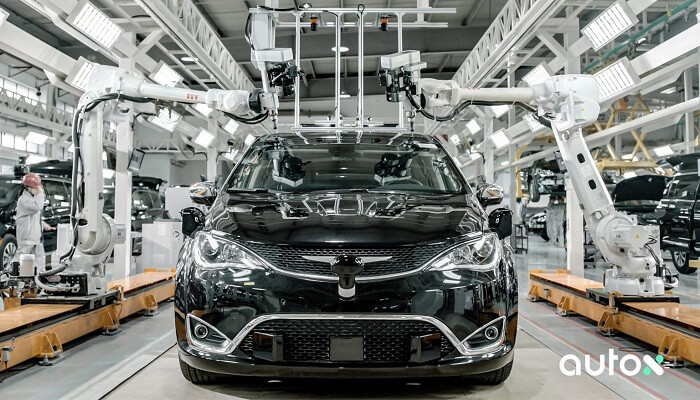
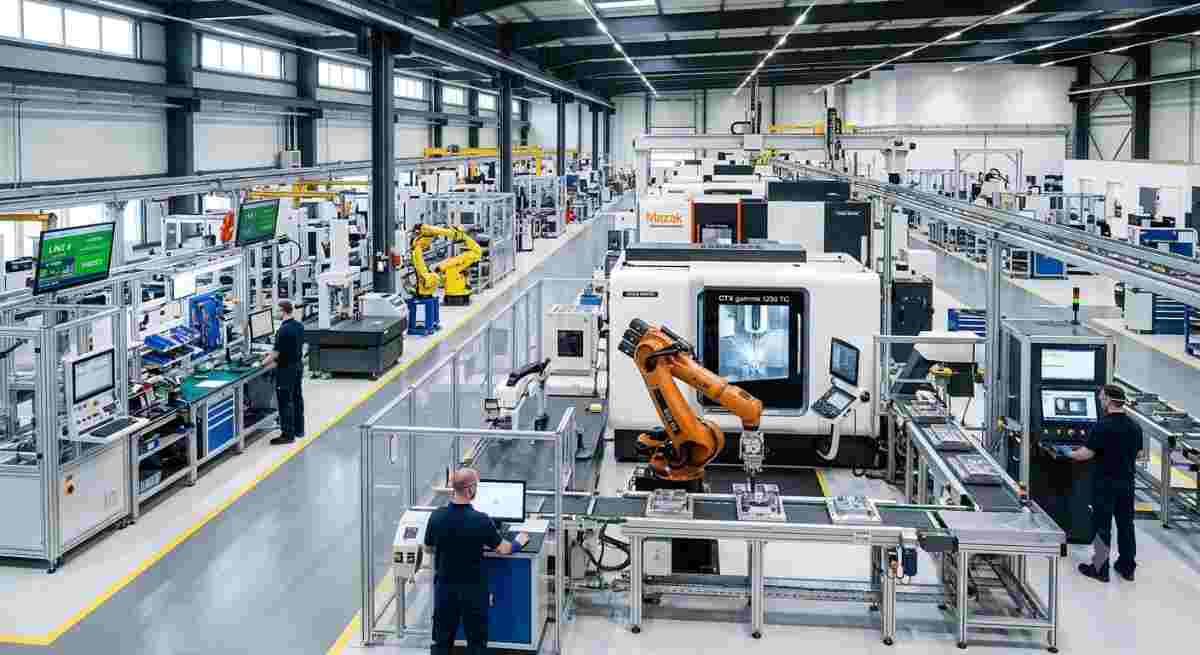
Across a wide range of environments, including manufacturing facilities, transportation infrastructure, and automated warehouses, industrial electronics continue to play an increasingly critical role.
However, in an era that has seen such industrial electronics pack in ever-more power at the same time as becoming more compact and interconnected, the need for effective thermal management systems should be no less obvious.
Why Heat Is Becoming More of a Concern for Industrial Applications
Heat may not exactly be the most visible of enemies, but this doesn’t make it any less lethal. If internal temperatures at an industrial site are allowed to go beyond recommended operating limits, this can lead to such dire consequences as:
=> Component degradation
=> Lower efficiency
=> System instability
=> The premature failure of equipment
Even in the most “favourable” conditions, electronic components will inevitably generate heat during operation. In the case of power supplies, processors, motor drives, and inverters alike, it can be anticipated that a certain amount of electrical energy will be converted into thermal energy.
However, the industrial landscape of the 2020s has also seen a tendency towards equipment being more densely packed, alongside spiralling processing demands.
This combination of circumstances makes it hugely important for engineers and facility managers to understand the challenges of thermal management.
If such professionals are able to lessen the risks of escalating heat at their sites, they can be well-placed to ensure the best possible operational efficiency, while preserving the reliability of their industrial systems.
4 Common Challenges with Managing Heat at Industrial Sites
Here are some of the major tests that decision-makers for industrial installations and premises can expect to face when it comes to heat management:
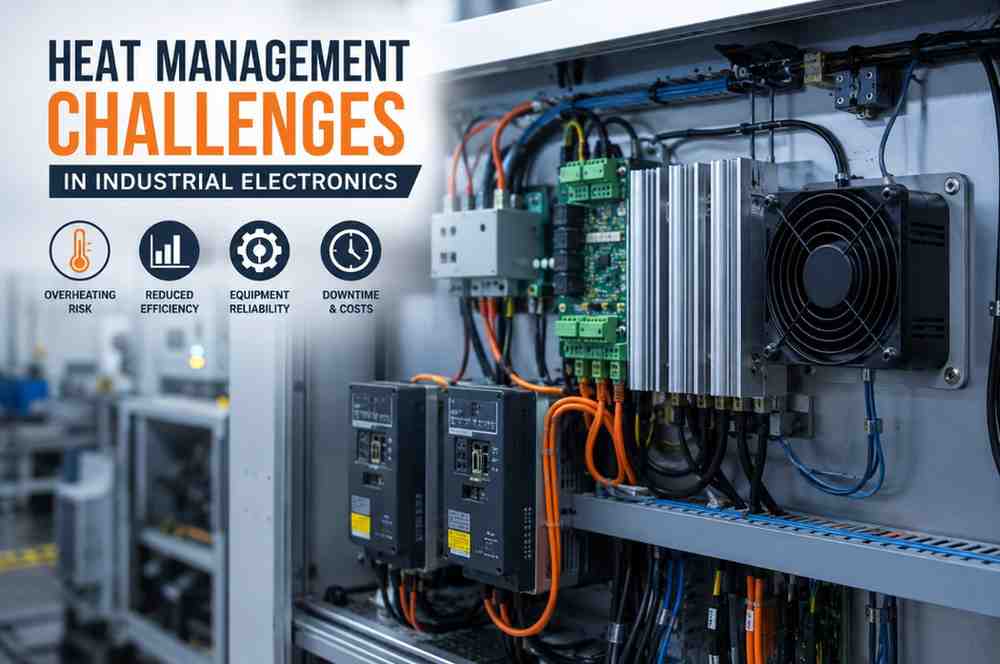
=> Increasing Power Density
The industrial electronics of today, even compared to the equivalents of just a few decades ago, deliver higher performance from more modest footprints.
This might sound like an unalloyed positive, indicating optimised efficiency and saved space. However, it can also have the effect of concentrating the generation of heat within certain confined areas of an industrial premises.
=> Harsh Operating Environments
It isn’t a secret that the conditions in which many industrial installations operate can be very punishing. Elevated temperatures, airborne contaminants, and fluctuating climatic conditions can neuter the effectiveness of passive cooling methods.
This doesn’t mean, of course, that facility managers should do away with such passive systems. Such high demands do, however, underscore the importance of getting the broader thermal management approach for a particular site right, and certainly not treating it as an afterthought.
=> Energy Efficiency Requirements
As governments around the world continue their “net-zero” drives, organisations across the sectors are still seeing plenty of reasons to drive down their energy consumption and firm up their sustainability credentials.
Yes, a certain amount of energy is expended by many cooling systems, which remain essential for keeping operating temperatures at safe levels. But engineers still need to consider how they can balance their premises’ thermal management requirements with the imperative to streamline energy usage and operating costs.
=> Equipment Reliability and Downtime
In today’s intensely competitive economic landscape, it is critical for industrial sites to avoid even relatively short periods of unexpected downtime. After all, any shutdown periods at all can have significant knock-on effects on productivity, delivery timescales, and the need for potentially expensive maintenance interventions.
Even modest increases in temperature can exert a significant influence on equipment reliability. As operating temperatures climb, component ageing tends to happen faster, corresponding with higher equipment failure rates.
Conclusion: The Importance of Investing in Effective Heat Management
Amid the continuing evolution of industrial systems in the “Industry 4.0” era, organisational decision-makers can’t afford to overlook or ignore the importance of effective thermal management.
Managing heat well at an industrial premises is unquestionably a major engineering challenge. However, investing time and funds into this element of a site’s operations can pay dividends in the form of higher-performing, longer-lasting, and more reliable industrial electronics.