-black.png)
Most people think of false advertising as a flashy problem. A dramatic before and after photo. A miracle pill. A loud commercial making promises nobody should believe. But in real life, deception is usually quieter than that. It often shows up in the split second when a shopper assumes a company is playing fair.
False Advertising Starts in a Moment of Trus
That is what makes the issue bigger than exaggeration. A silly slogan is one thing. A claim that changes how someone spends money, judges risk, or compares options is something else entirely. The same basic instinct people use when picking a grocery brand or evaluating a finance app for couples is built on a simple expectation: the important facts should be true. If the facts are distorted, the purchase is not really a free choice.
The Real Harm Is Manipulation
Puffery has always existed in advertising. “World famous,” “premium quality,” and “best ever” are usually understood as opinion or hype. Consumers hear those phrases and mentally discount them. The legal and ethical problem begins when a business presents something measurable as if it were settled fact.
That can mean claiming a product contains an ingredient it does not contain. It can mean saying a fee does not exist when it absolutely does. It can mean inventing urgency with countdown timers that reset every time the page reloads. It can also mean making health or performance claims without real evidence behind them. The Federal Trade Commission explains that advertising claims must be truthful, not deceptive or unfair, and backed by evidence when required. FTC guidance on advertising and marketing basics makes that standard plain.
Seen from the consumer’s side, the problem is not just that someone was “fooled.” The deeper issue is that deception interferes with decision making itself. False advertising hijacks comparison. It breaks the normal process people use to weigh price, quality, safety, and value.
Hidden Fees Are a Form of False Storytelling
One of the most common forms of deception does not even look like traditional advertising. It looks like pricing.
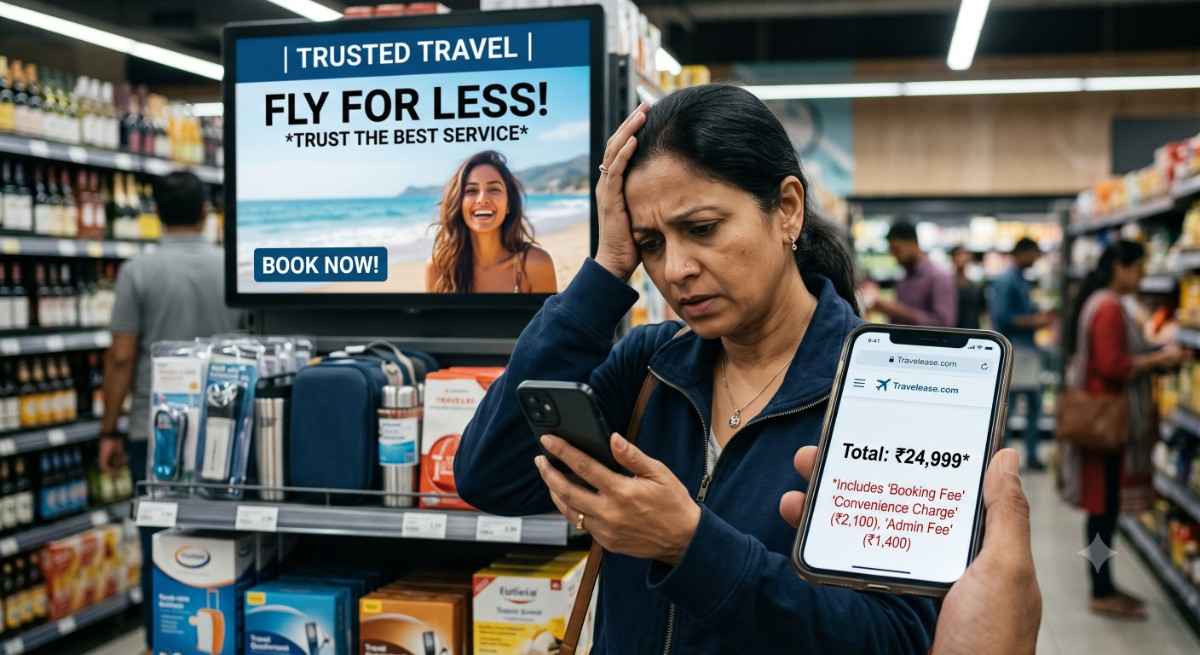
A company says a product costs one amount, but the real amount appears later through service charges, processing fees, mandatory add ons, or conditions buried in tiny text. Technically, the ad got your attention with one number. Practically, the company used that number to get you emotionally committed before revealing the truth.
That matters because shoppers rarely make choices in a vacuum. They compare options quickly. If one business advertises a lower price than its competitors, it may win the click, the visit, or the sign up before the consumer learns the comparison was rigged. By then, time has been spent, alternatives feel farther away, and many people just continue with the purchase. The deception works because it exploits momentum.
In that sense, false advertising is often less about lies in a sentence and more about lies in the buying journey. The ad creates a false version of reality, then counts on people being too busy to fight through it.
Health Claims Show Why Evidence Matters So Much
The sharpest line between hype and deception appears in health related marketing. If a business claims a supplement, cream, device, or drink can treat, cure, or prevent a condition, most consumers will hear that as a factual statement, not a poetic one. Those claims can shape decisions about money, safety, and actual medical care.
That is why unsupported clinical language is so dangerous. Words that sound scientific can create the illusion of proof even when no credible proof exists. The Food and Drug Administration tracks many products that have been flagged for health fraud concerns, including products marketed with unlawful or misleading disease related claims and products with undeclared ingredients. The FDA’s health fraud product database shows how often marketing can cross from persuasive into hazardous.
This is where false advertising stops being a consumer inconvenience and starts looking like a public health issue. People may delay treatment, waste money they cannot spare, or expose themselves to substances they never agreed to take. The ad is not merely overstating benefits. It is tampering with informed consent.
Scarcity Tricks Work Because People Fear Missing Out
Another underestimated form of false advertising is fake scarcity. “Only two left.” “Sale ends in ten minutes.” “Twenty three people are viewing this now.” These messages are powerful because they do not just describe a product. They pressure the consumer’s state of mind.
Scarcity can be honest when it reflects reality. A limited inventory is a real fact. A short promotion can be legitimate. But when scarcity is fabricated or mechanically recycled, it becomes a psychological trap. The point is not to inform. The point is to shrink the time available for reflection.
That tactic matters because consumers make worse decisions when they feel rushed. They read less carefully. They compare less thoroughly. They overlook return policies, subscription terms, and extra charges. In other words, false scarcity does not merely add excitement. It reduces the buyer’s ability to protect themselves.
Why “Everyone Should Know Better” Is the Wrong Response
There is a common reaction to deceptive marketing that goes something like this: smart consumers should be more skeptical. Of course skepticism helps, but that response misses the scale of the issue.
Advertising systems are built by specialists who test language, layouts, color choices, timing, and emotional triggers. Consumers, meanwhile, are shopping while tired, distracted, stressed, and short on time. The law does not ask whether a perfect superhuman shopper could have spotted the trick. It asks whether a practice is materially deceptive.
That is an important distinction. False advertising law exists because markets work better when businesses compete on real value instead of fake impressions. Honest companies should not lose sales to businesses willing to bend reality. Consumers should not need detective skills to buy soap, book travel, or compare subscriptions.
The Best Question to Ask Is Simple
When an ad makes a claim, the useful question is not “Is this persuasive?” It is “Would this matter if I knew the truth?”
If the answer is yes, the claim is probably material. If a person would choose differently after learning the real ingredients, the real evidence, the real price, or the real availability, then the deception is not trivial. It goes to the heart of the transaction.
That is why false advertising is more than exaggeration. Exaggeration lives in the world of opinion. False advertising lives in the world of distorted choices. It changes what people think they are buying, what they think they are paying, or what they think they can expect.
Trust Is the Real Product Being Sold
At the end of the day, every ad sells two things. It sells the item itself, and it sells confidence in the seller. Once a company trades on trust with claims it cannot support, the damage spreads beyond one purchase. Consumers become more cynical, legitimate businesses face more suspicion, and the market gets noisier and less fair.
That is why truthful advertising matters so much. It is not about banning enthusiasm or personality in marketing. It is about protecting the line between persuasion and deception. Consumers can handle hype. What they cannot fairly navigate is a system that hides facts, invents proof, or pressures them with a false version of reality.
And that is the point worth remembering: false advertising is not simply speech that sounds too bold. It is conduct that corrupts choice.