-black.png)
Databases act as the backbone of software systems and applications, as the data they store is indispensable for the functioning of the respective organizations. At times, the database becomes inaccessible due to several errors. For instance, it acquires a recovery pending state when some missing resources or storage issues prevent the database engine from starting the recovery process.
Leaving such issues unresolved can cause extended downtime, failed operations, and loss of sensitive data. Routine health monitoring can help to track the state of the database and identify the early warning signs of a recovery pending state, much before its occurrence.
An automated database health monitoring is even better equipped to avert such errors. It boosts the efficiency, reliability, and security of the database through advanced methods and without human intervention. This blog discusses in detail the measures necessary to prevent SQL Server recovery pending State through automated database health monitoring.
What is a recovery pending state?
When the SQL Server database requires recovery but cannot start the recovery process because of inaccessible database files or resource limitations, it enters the recovery pending state. The database remains in this state unless you resolve these underlying errors.
Here are the key reasons leading the database to a recovery pending state:
• Abrupt shutdown: An unexpected power outage can cause a server crash or hardware failure, leaving the files in an inconsistent state.
• Missing files: A deleted, renamed, or missing MDF or LDF file can cause severe database issues, one of them being the recovery pending state.
• Insufficient disk space: If the host drive does not have enough free space, it prevents SQL Server from carrying out the recovery process after a crash.
• Storage issues: The storage drive containing the database may be detached, slow, or offline during server reboot.
• Permission issues: The SQL Server account does not have read/write permissions to access the folders consisting of the database files.
While it is crucial to resolve the recovery pending state while taking care of all these factors, a better and more encouraging approach would be to prevent the issue from occurring firsthand. This is possible through proper database health monitoring, which you can do both manually and through automated tools.
What is database health monitoring?
A database health check refers to monitoring the condition of a SQL database to detect and troubleshoot problems arising in the database environment. These issues could relate to performance, configuration, or errors like the suspected state or recovery pending state. Organizations perform database health monitoring through both manual and automated methods, depending on their budget.
Manual check relies largely on manually reviewing logs, dashboards, and periodic queries to gauge system performance. Likewise, automated monitoring uses advanced tools to check databases, find issues, and perform predefined corrective actions in real time. The absence of human intervention makes the database free from manual errors, preventing downtime and ensuring integrity.
Prevent recovery pending state through manual health monitoring
Here are a few easy steps to consider while monitoring SQL Server database health manually
• Disable AUTO_CLOSE property: Check the AUTO_CLOSE option in your database settings. If it is enabled, disable it, as it may lock the resources momentarily, to drag the database to
recovery pending state.
You may also do it through the following T-SQL query:
ALTER DATABASE [Your Database Name] SET AUTO_CLOSE OFF;
• Optimize disk space: Configure the monitoring tools to flash alerts when disk capacity goes below 15-20%
• Secure proper file permissions: Ensure to retain uninterrupted and explicit permissions to access the location of your MDF and LDF files.
• Avoid Raw File-Level Backups: Do not create traditional file-level backups when the SQL Server instance is still running, as it can corrupt the transaction logs currently running. Instead, use VSS-enterprise software or SQL Server native backup tasks
These manual methods can help to prevent the recovery pending state and several other related errors. However, opting for automated database health monitoring would always be a better option due to reduced human intervention.
How does automated database health monitoring prevent recovery pending state?
DBAs use SQL Server Agent, the Microsoft Windows service built-into SQL Server to automate routine database administration jobs. Besides, several advanced tools available online can be a suitable alternative to help you prevent SQL Server recovery pending State. Most of them allow you to carry out the health monitoring over the web, through their online SQL repair service. These applications can automate several crucial tasks:
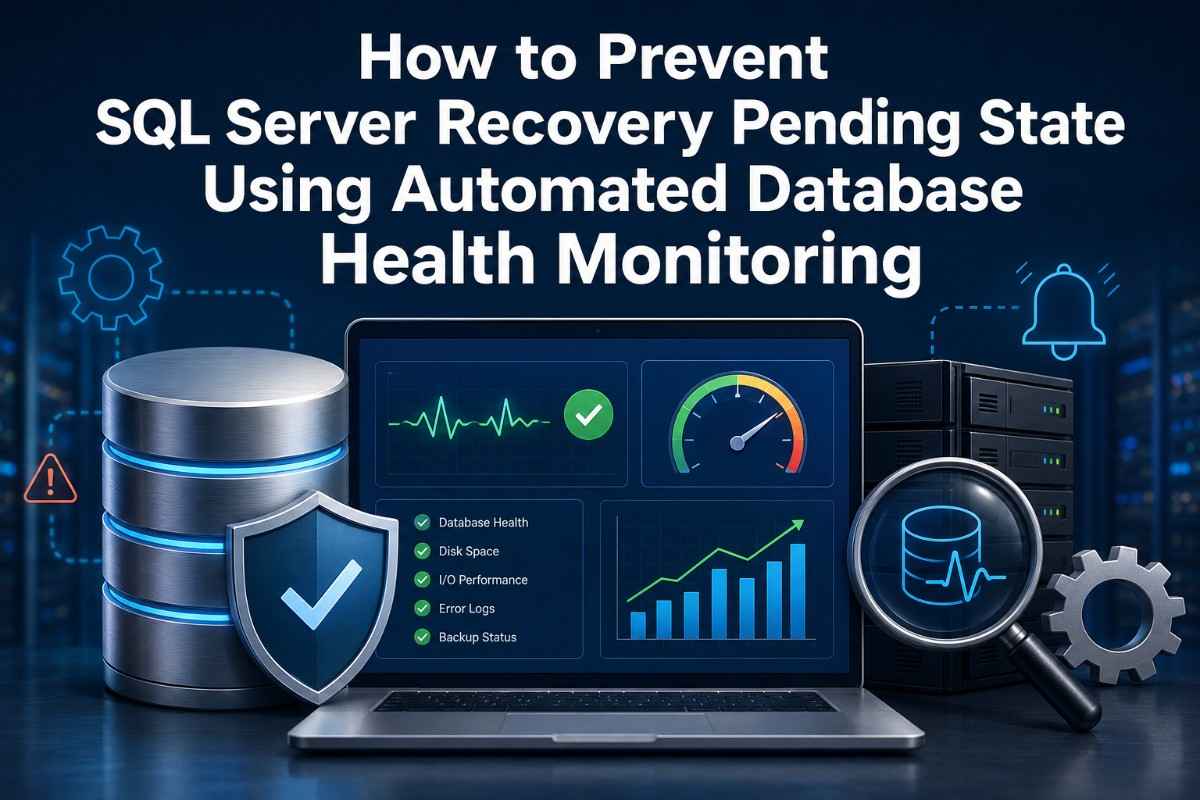
• Disk space usage monitoring: Check the database for space availability and create an alert when the storage goes below the threshold value.
• Check database for files: The automated tools verify accessibility of the required MDF, NDF, and LDF files, along with ensuring storage availability.
• Real-time alerts: Tools, such as SQL Server Agent, read the database log and compare it with the defined events. In case of a match, the tool triggers an alert as an automated response to an event.
• Check error logs: Automated monitoring of SQL Server error logs helps to detect problems, such as database corruption, file access failures, or disk issues, at an early stage.
• Storage and I/O issues: Health monitoring tools sense the warning signs of failing storage devices before they fail by checking the read/write latency, storage connectivity, and several I/O errors.
• Monitor database backup and integrity: The automated tools can verify successful backup completion, monitor integrity checks, and fire alerts in case of failed backups or consistency checks.
• Early identification of crucial issues: Automated monitoring allows tools to identify storage constraints, low-performance traits, and configuration issues at an early stage.
Using an online SQL repair service for database repair and maintenance
While SQL Server Agents can work as efficient tools for automated health monitoring, they may fail to identify several checks, leading to the recovery pending state or similar errors arising. Several third-party SQL recovery applications are effective in handling the error in such a situation. Among the many tools available in the market, Stellar Repair for MS SQL can be a feasible option.
The tool provides an online SQL repair service, freeing you from installing and downloading it on your system. If you come across any unresolved SQL Server recovery pending State in your database, the Stellar software can help to repair and recover it quickly. You just need to upload the problematic file and start the repair process online. The tool will efficiently fix the error and make the database file ready for mounting.
Conclusion
SQL Server database holds high significance in organizations owing to the crucial data it contains. The DBAs apply all their skills and expertise to ensure the proper functioning of the database. However, despite their persistent efforts, several reasons may lead to unavoidable issues. Prominent among these may include SQL Server recovery pending state, suspect state, and so on.
While several crucial methods are available to fix the issues causing the database to enter these states, it is even better to stop them first-hand. This is where regular health checks of the databases can prove effective. You can try manual or automated database health monitoring to prevent SQL Server recovery pending State and similar issues.
For example, SQL Server Agent, an in-built Microsoft Windows service tool, helps to monitor the database health. Several third-party tools can also execute this task with success. In case the health check fails to detect the database errors, you can use several online SQL repair service tools, such as Stellar Repair for MS SQL, to fix the issue and prevent SQL Server recovery pending State from occurring again.