-black.png)
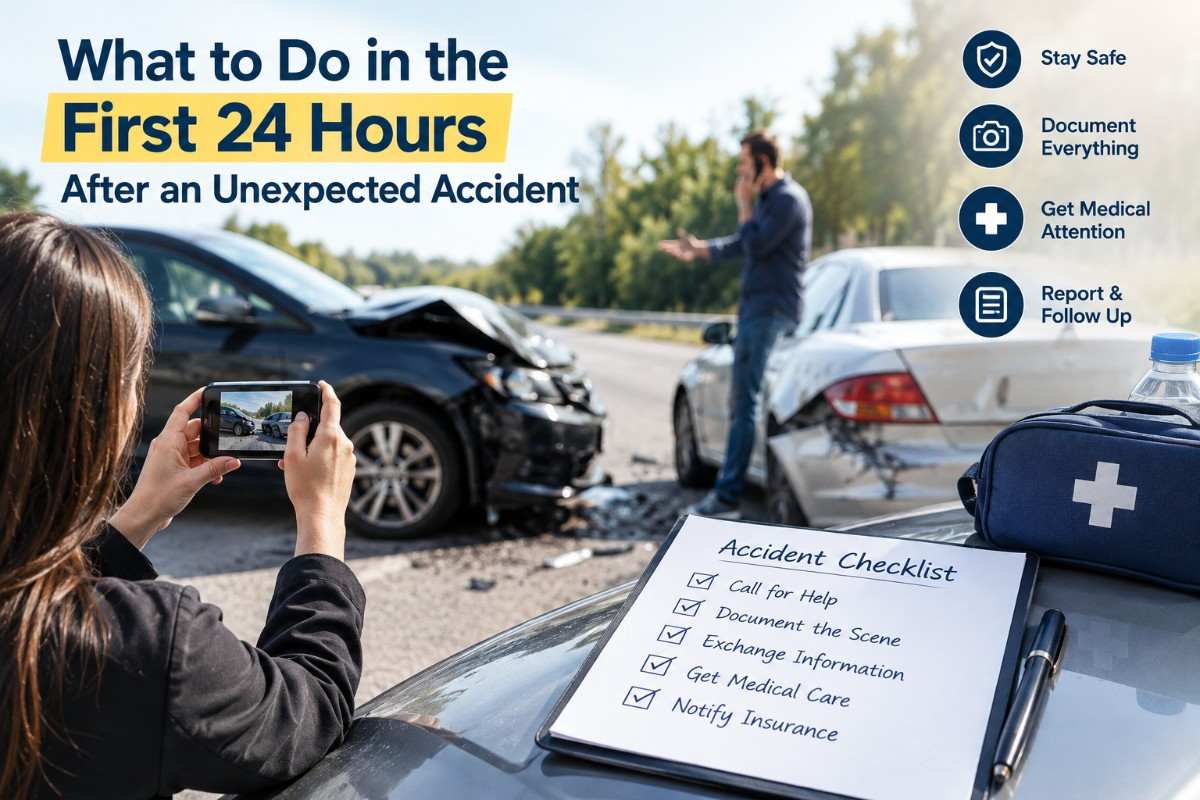
Sixty seconds. That is roughly how long it takes for the world to flip upside down after a collision, a slip, or a dog bite. Your heart is pounding, your brain is static, and every instinct you have is probably wrong. The good news? You do not need to be perfect in that chaos. You just need a simple, repeatable plan for the next 24 hours, and I am going to give you one.
This guide walks you through each phase of that first day, from the immediate aftermath to the moment you finally get some sleep. You will learn what to document, what to say, what to skip, and the exact order to handle things so you do not accidentally weaken your position later.
Why the First Day Sets the Tone for Everything
Here is the thing about accidents: they do not just hurt your body immediately. They hurt your case, your insurance claim, and your recovery if you fumble the opening moves. The first 24 hours are when evidence is freshest, witnesses are still around, and your memory is at its sharpest. That window closes fast.
Think about what fades after a few days. Bruises heal. Skid marks get washed away. The guy who saw everything becomes harder to track down. Your own recollection of the exact sequence of events gets muddled with adrenaline and stress. Capturing the moment while it is still raw is not paranoia, it is just smart.
And it is not just about proving fault. The decisions you make in those first hours, like whether you see a doctor or what you say to the other driver's insurer, can shape the entire weeks that follow. Get them right, and the process is still annoying but manageable. Get them wrong, and you are digging out of a hole.
Right After the Incident: Your First 30 Minutes
The first half hour is pure survival and stabilization. Do not skip it, but do not overthink it either. Here is the order of operations:
- Move to safety, then stop. If you are on a road, get out of the flow of traffic if you can. Then stay put. Leaving the scene, even to "just go home," can be a legal mess.
- Call for help. Whether you need an ambulance, the police, or both, make that call first. If there is any doubt about injuries, err on the side of medical help.
- Do not apologize. This is the hardest one for polite people. Saying "I'm sorry" can be read as admitting fault, even when you mean it as sympathy. Say "Are you okay?" and leave it there.
- Exchange the basics. Names, phone numbers, insurance info, license plates. Stick to the facts on the required info, nothing more.
That last point deserves a little more weight because it is where most people trip up. You want to be a decent human, and the other person might be perfectly nice. Fine. Be decent. But do not narrate your theory of how it happened, do not speculate about what you saw, and do not discuss your injuries in detail. The police report and the insurance companies will sort out the narrative.
The Evidence Hunt: What to Capture Before You Leave
Your phone is the best tool you have, so use it like a detective. The scene will not stay the way it is for long, so grab these before you go:
- Wide shots of the entire area from several angles
- Close ups of damage, visible injuries, and any hazards like wet floors or debris
- The other vehicle's plates and damage, if vehicles are involved
- Road conditions, weather, signage, and lighting
- Contact info for witnesses, not just their statement
CDC data from 2022 shows that unintentional injuries are a leading cause of emergency department visits in the United States, which means a lot of people are standing in your shoes every single day. The ones who fare best in the paperwork war are the ones who documented everything while their hands were still shaking.
And yes, this feels awkward. People stare when you pull out your phone and start photographing a parking lot. Let them stare. A few minutes of discomfort protects you for months.
Medical Care: The Visit You Cannot Put Off
Here is the scenario that plays out constantly. You feel fine. Maybe a little stiff, but the adrenaline is still buzzing through you. You decide to skip the ER and sleep it off. Then you wake up at 3 a.m. with your neck in a knot and a headache that won't quit.
Adrenaline masks injuries. It is a biological fact, not a moral failing. So if you were in anything more than a fender bender, get checked out promptly. If you had a serious crash, go to urgent care or the ER that day, not next week. A delayed medical visit gives insurance adjusters room to argue your injuries happened somewhere else.
And here is a practical tip: tell the doctor exactly what hurts, where, and how it feels. Do not downplay it. Do not "tough it out." You are not being dramatic, you are giving clinician data. Write down symptoms in your phone before you walk in so you do not forget half of them under the fluorescent lights.
Handling Insurance Calls: The Script You Need
Your phone will start ringing fast. Your own insurer, maybe the other party's, maybe a friendly "claims specialist" who wants to help. Here is the truth about those calls: your only job is to report the basic facts of the incident. That is it.
You do not need to give a recorded statement for the other side. You do not need to estimate your injuries or your pain level on the spot. You do not need to accept the first settlement offer, ever. And you certainly should not sign anything that releases them from liability while you are still figuring out your medical situation.
A quiet but firm phrase works well: "I am still being evaluated by medical professionals, and I will have my counsel contact you." You do not need a lawyer yet to say that, you just need to say it with confidence. National trends back this up. Insurance Information Institute reporting on 2023 auto claims data shows that bodily injury claims often take months to reach a final resolution, so there is zero reason to rush into anything on day one.
If this all feels overwhelming, that is where a personal injury lawyer Denver residents rely on becomes useful. Even a quick consultation can tell you what to say and what to hold back, and most firms will not bill you for the first conversation.
The Medical Records Trail: Starting It Right
The single most underrated thing you can do in the first 24 hours is establish a clear paper trail. When you do see a doctor, make sure the visit is documented. Get a copy of the discharge papers. Keep the appointment card. Write down the doctor's name and the diagnosis code if they give you one.
Why does this matter? Because months from now, when a claims adjuster asks "what exactly was your injury?" you want a clean, contemporaneous record that says it, not a fuzzy memory of a conversation you half slept through.
One thing I tell everyone: take a photo of the paperwork before you leave the office. That way you have it even if the physical copy gets lost in a pile of mail. In the future you will be grateful.
What You Should Absolutely Not Do in Those 24 Hours
Equal parts "do this" and "do not do this." Some of these seem obvious in hindsight, but they are the exact moves people make when they are rattled:
- Do not post about it on social media. Not a photo of the car, not a status update about your sore back. It becomes evidence, and it reads differently than you intend.
- Do not discuss fault with the other party's adjuster. Be cordial, exchange info, and refer them to your representation.
- Do not throw away anything. Keep the torn shirt, the broken sunglasses, the damaged phone, the ruined shoes. They are physical evidence of impact.
- Do not accept a check yet. A quick settlement in the first day or two almost never covers your full medical picture. Slow down.
That social media one is the one people fight me on. "I only posted it to my private account!" Fine. Private accounts get screenshotted too. The adjuster's software scrapes public profiles daily, and even a "private" slip can come back to haunt you if it lands in the wrong hands.
Your Evening Checklist: Winding Down Properly
By the evening, the adrenaline has worn off, and the exhaustion hits. This is when the details blur, so take thirty minutes to lock everything in:
1. Sit down with your phone's note app and write the whole sequence from start to finish, including times and details you remember.
2. Review the photos you took, and take a few fresh ones of any new bruises or stiffness.
3. Keep a log of symptoms, however minor. Write down "headache at 8 p.m." and "stiff neck at 10 p.m." It sounds silly now, but it becomes a timeline later.
4. Set an alarm to follow up with a doctor tomorrow if you did not go today.
If you struggle to sleep because your mind is racing, that is normal. It is also worth writing down. Sleep disruption after an incident is common and often documented in medical literature as a secondary effect of stress, so do not discount it as "just nerves."
The Mental Side That Nobody Prepares You For
Here is the part that does not fit neatly into a checklist. The day after an accident, you might feel weird. Anxious. Jumpy. Irritable. That is not weakness, it is a normal response to an abnormal event. Your nervous system just spent hours in survival mode, and it does not switch off just because the sun came up.
Give yourself grace for the next few days. Do not schedule big meetings or hard conversations. Let people help you. And if the anxiety lingers for weeks and starts interfering with your life, that is worth bringing up with your doctor too. Your mental recovery is part of your overall recovery, even if no insurance form asks about it directly.
Your Next Move: A Simple Decision Framework
So you made it through the first day. What happens tomorrow? Here is a straightforward way to think about it. If your injuries are minor, your damage is minimal, and the fault is clear, you can probably handle the paperwork yourself with some patience. If you need medical attention, if fault is disputed, or if the other side is already being difficult, that is the signal to get professional help involved before things harden.
Most reputable personal injury firms offer a free consultation specifically so you can ask "is this something I should handle alone?" without committing to anything. There is no downside to asking that question. Worst case, they tell you "you are fine, go handle it," and you saved yourself a fee. Best case, they flag a landmine you did not even see coming.
Take the list from this article with you, check off each item as you go, and let the process unfold. You cannot control the accident after it happens, but you absolutely control how you respond to it. That is the whole game.